
Running a Sex Offender Check in Palo Pinto County
The Texas Public Sex Offender Registry is the main free public channel for Palo Pinto County. Texas DPS maintains the statewide data under Code of Criminal Procedure Chapter 62. A city police department registers a qualifying resident inside its municipality. The Palo Pinto County Sheriff's Office is the registering authority for a resident outside a municipality. Those local records are sent to DPS for statewide publication.
Prepare a full name or a specific place before searching. A name search helps locate one known person, while address, city, ZIP, county, map, and list tools support neighborhood awareness. Confirm aliases, photo, physical description, address, and offense facts before drawing a conclusion. Similar names can refer to different people, and a profile is not a personal risk score.
The official Texas registry search interface shown below is the primary Palo Pinto County source.
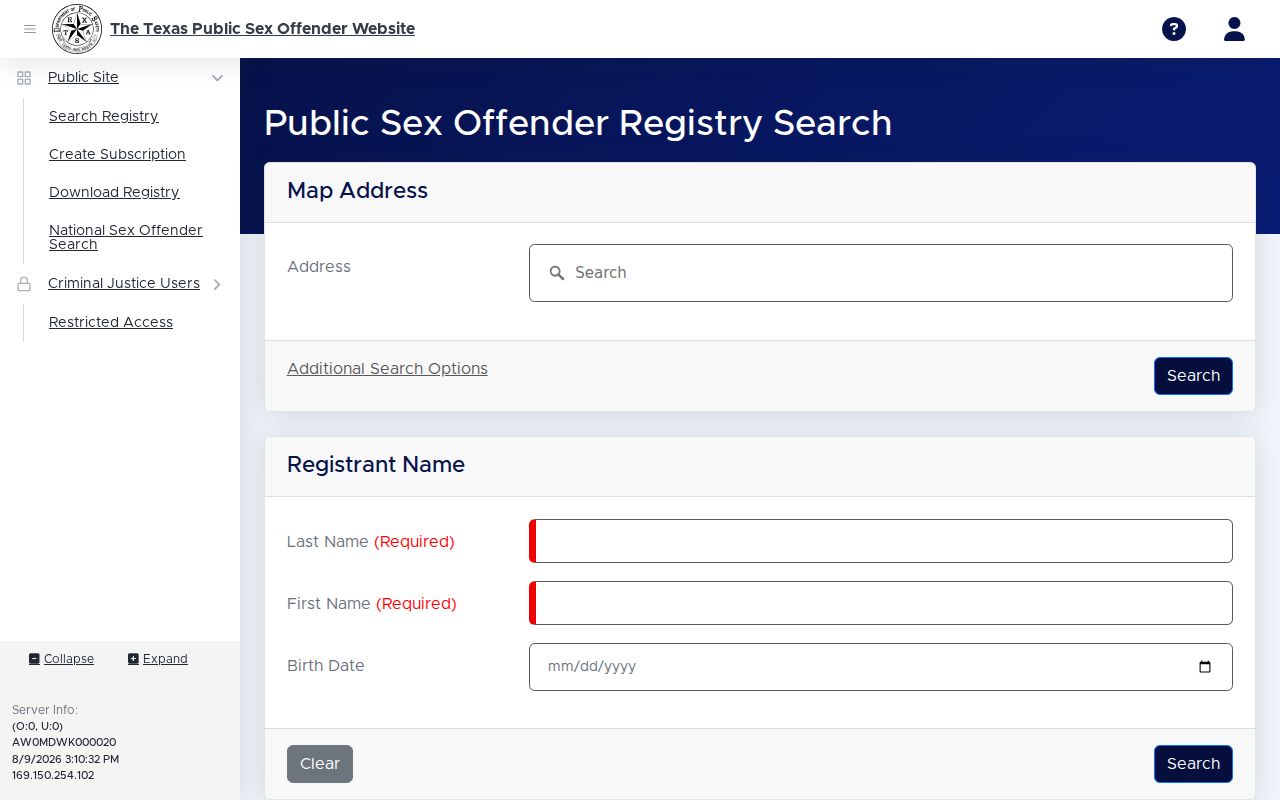
The county filter and location search help separate Palo Pinto County results from similar names elsewhere in Texas.
Palo Pinto County Offender Registration
Registration begins with the authority for the person's residence. Municipal police, including the Mineral Wells Police Department, handle registrants inside their city. The Palo Pinto County Sheriff handles residents outside a municipality. The local authority verifies required information and transmits it to Texas DPS. The Sheriff's published general location is 420 Cedar Street, Palo Pinto, Texas 76484, with the main number 940-659-2085. The research did not locate separate appointment hours or a local registration fee, so call before traveling.
This local-to-state path explains why suspected noncompliance should be reported to the registering police department or the Sheriff, not merely noted on a web search. The county department directory provides the official local-office route. Failure to comply with Chapter 62 can be a felony. Give the authority the profile and location facts that prompted concern, and avoid personal contact or confrontation.
The DPS registration program page explains the statewide process reflected in the image below.
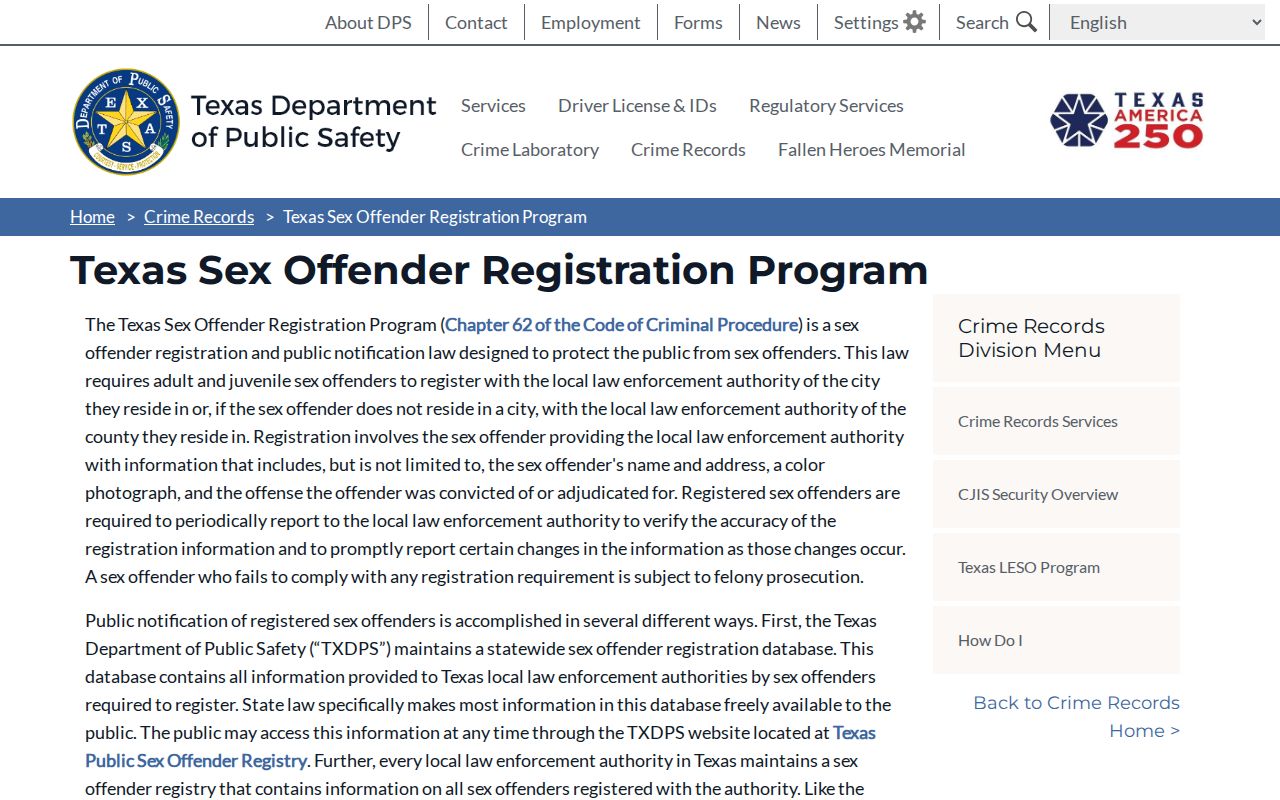
That program page connects a Palo Pinto County registration appointment with the public statewide record that residents later search.
Searching the Texas Public Sex Offender Registry
DPS offers public name and location paths. Exact dropdown and radius choices can change and were not fully exposed in the accessible source, so use only options shown on the live form. A county selection is useful for a broad Palo Pinto County check. An address search is better for a point near a home, school route, or family gathering place.
- Open the official Texas DPS registry and review its conditions of use.
- Choose a name search or enter the address, city, ZIP, county, and radius controls shown.
- Review map or list results, then match more than one identity field.
- Open the full profile and read the address, offense, registration, and compliance details.
| Search control | Type | Required | Use |
|---|---|---|---|
| Name search | Tab and form | Search-dependent | First and last name path |
| Address search | Tab and form | Search-dependent | Street, city, ZIP, and displayed radius controls |
| County | Dropdown | Optional path | Select Palo Pinto for county scope |
| Map or list | Results display | Not applicable | Compare geographic and list views where offered |
| Search or Clear | Buttons | Not applicable | Run or reset the form |
When results are broad, narrow the location or add reliable identity facts. Never assume the first name match is the right person.
Palo Pinto County National Offender Search
The Dru Sjodin National Sex Offender Public Website, or NSOPW, is the U.S. Department of Justice layer for a search across participating jurisdictions. It is useful when a person has moved across state lines or when a location check should extend beyond Texas. It does not replace the detail and local registration context on a Texas DPS profile.
Search both systems when the question crosses a state boundary. Compare the listed jurisdiction, aliases, photograph, physical traits, and offense fields rather than relying on a name alone. Return to the state source for the most direct Texas program explanation and to the local registering authority for a suspected Palo Pinto County compliance issue.
The official NSOPW national search is pictured below as the source for that broader check.
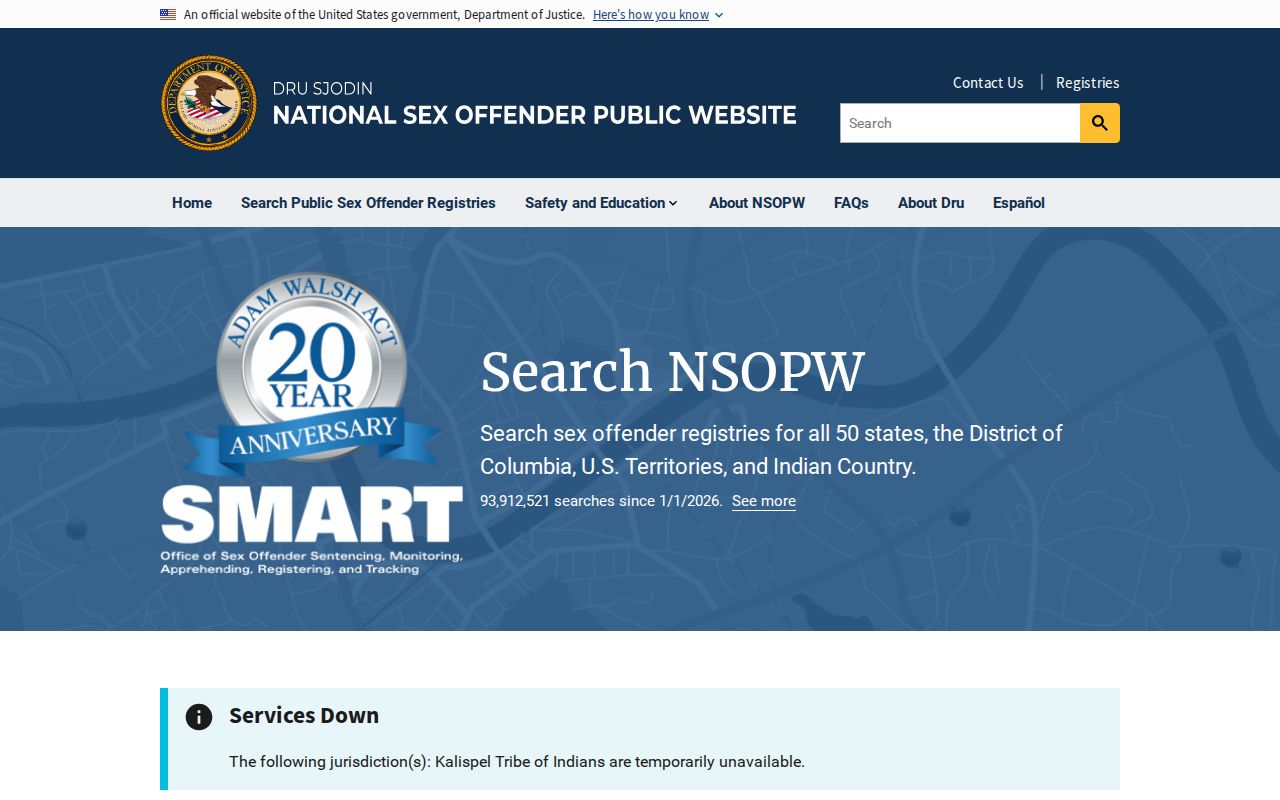
NSOPW widens the geographic scope, while Texas DPS remains the core state registry for Palo Pinto County.
What a Registry Profile Shows
A public DPS profile may show identity, location, offense, and compliance facts. It can include a name, aliases, color photograph, physical description, registered address, conviction information, registration status, institutional or campus status, and qualifying vehicle details. Read each field in context. A listed conviction is not the same thing as a current charge, and registration duration follows the governing offense and statute.
| Name and Aliases | Published identity names used to distinguish possible matches. |
|---|---|
| Photo and Description | Color image and physical traits available for visual comparison. |
| Registered Address | Public residence or location information allowed by Chapter 62. |
| Offense Information | Qualifying offense and conviction details shown by DPS. |
| Registration Status | Compliance and registration information published on the profile. |
| Vehicle or Campus Fields | Qualifying vehicle details and institutional or campus status when applicable. |
DPS does not publish Social Security numbers, driver-license numbers, phone numbers, online identifiers, employer details, victim identity, designated confidential data, or juvenile information made nonpublic by court order.
Palo Pinto County Registry Privacy Limits
Most Chapter 62 registration data is public, but the statute draws firm lines around sensitive fields. A public profile is therefore an approved subset of the registration file, not the full file held by DPS and the local authority. Missing phone, employer, victim, or online-identity details are not evidence of an incomplete local report. They are fields kept from public view by law.
The DPS criminal-history and registry FAQ explains public and nonpublic data, plus the scope of Texas residency law. Its captured page appears below.
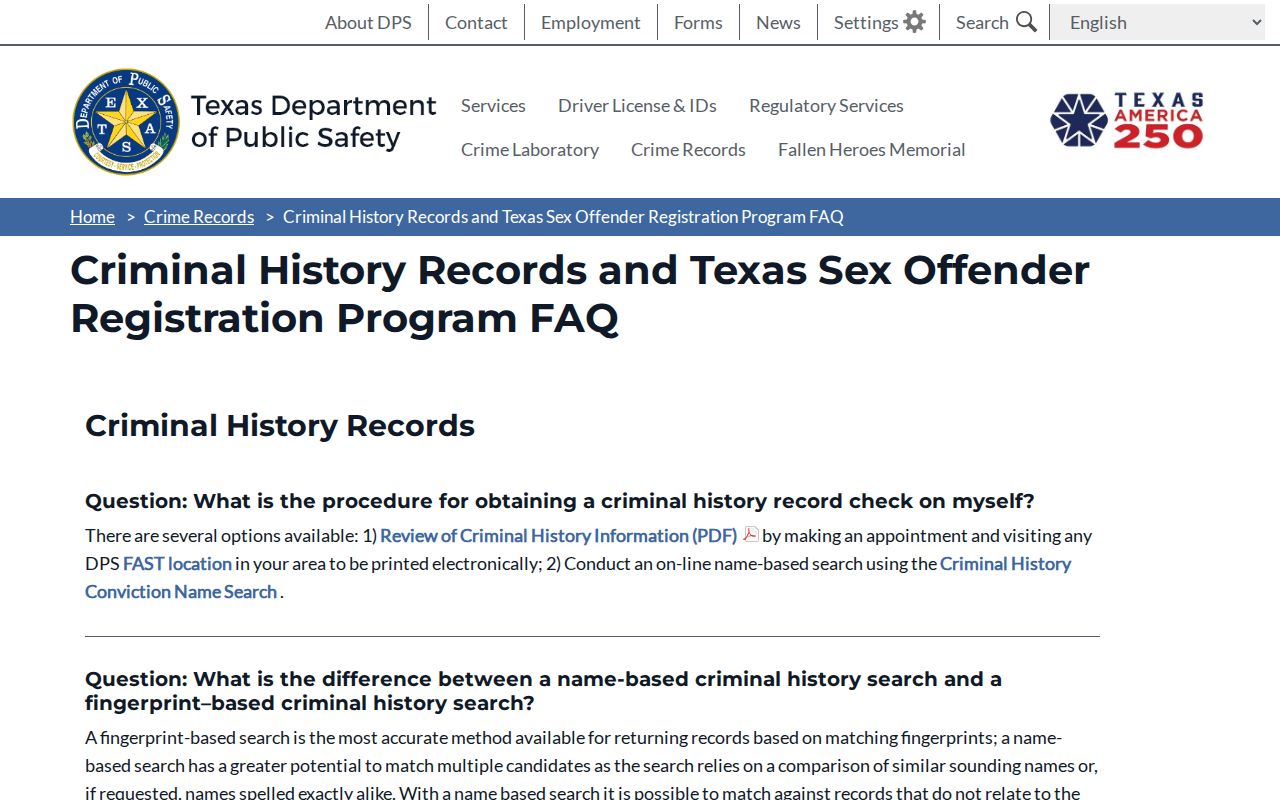
That distinction protects private identifiers while leaving the core facts intended for community awareness available through the registry.
Note: A public Palo Pinto County registry profile is not the registrant's complete government file or a formal risk assessment.
Registration Requirements and Levels in Texas
Texas does not use a simple public Tier I, II, and III chart as the controlling label for every registrant. Duty length is offense-specific. Chapter 62 generally provides lifetime registration for listed offenses and circumstances, and a ten-year period after release, discharge from community supervision, or completion of the court disposition for other reportable convictions. Juvenile duties and early termination follow distinct rules.
| Texas duty category | Duration | Verification frequency |
|---|---|---|
| Specified lifetime duty | Lifetime when Chapter 62 lists the offense or circumstance | Annual unless another rule applies |
| Other reportable conviction | Generally ten years from the controlling release, discharge, or completion point | Annual unless another rule applies |
| Specified repeat convictions | Underlying statutory duration | Every 90 days |
| Civilly committed sexually violent predator | As governed by applicable law | Every 30 days |
Read Chapter 62, including Articles 62.058 and 62.101, for the current rules. Do not substitute a generic federal tier chart for Texas law.
Palo Pinto County Offender Residency Rules
The DPS FAQ states that Chapter 62 is otherwise silent on broad residency restrictions based solely on registration, apart from a higher-education campus provision. That does not mean no individual limit can apply. Community supervision, parole, or a valid local ordinance may create a separate restriction. The exact order and governing authority must be checked rather than inferred from the public profile.
This point prevents a frequent error in Palo Pinto County registry use. A map pin does not by itself prove that a residence violates a distance rule. Report a concrete concern to the registering local authority and let officials compare the facts with the person's legal conditions. Never confront a listed person or household.
Palo Pinto County Registry Notices
Texas DPS provides mailed community notification when a high-risk offender or a civilly committed sexually violent predator moves into a community. That named program works alongside the public search and local verification process. It is not a list of every Palo Pinto County registrant and should not be treated as one. A resident who does not receive a postcard can still use the registry for a current area check.
Local registration feeds the DPS database, while DPS handles this high-risk move notification. If a profile appears to show noncompliance, preserve the public page details and contact the relevant police department or the Palo Pinto County Sheriff. The authority can check information that is not public and decide whether an investigation is needed.
Lawful Use and Community Notification
Use Palo Pinto County sex offender information for personal and family safety, neighborhood awareness, and informed planning. Match records with care and keep the inquiry tied to official sources. Registration data can change, and the local authority holds nonpublic facts that a public user cannot see. Verify urgent safety concerns with law enforcement.
Chapter 62 makes most registration information public, but it does not authorize harassment, threats, intimidation, vigilantism, or unlawful use. The registry exists to inform the public and support lawful notification. It does not deputize a searcher to investigate, punish, or confront a person.
Misuse is a crime: Do not use Palo Pinto County registry information to harass, threaten, intimidate, or commit another unlawful act under Texas Code of Criminal Procedure Chapter 62.
The official Chapter 62 text is shown below because it controls public access, registration duties, and limits surrounding a Texas registry check.
Current statute text, not a generic tier summary or unofficial list, should guide how a Palo Pinto County registration record is read.