
How to Check Criminal History in Strawn
Start a Strawn criminal-history search by naming the exact record. The City Secretary is the strongest published city fallback for municipal documents and public-information requests. The police page does not offer a separate records desk, downloadable form, blotter, app, or case search. That makes a focused request much more useful than a broad demand for everything tied to a name.
Follow these five steps for a Strawn record check:
- Identify whether the source is a Strawn police report, citation, county booking, county prosecution, or Texas criminal-history record.
- For a city incident, contact the City Secretary and identify “Strawn Police Department,” the date, location, incident or citation number, and desired document.
- Call or visit Strawn Municipal Court for a qualifying ordinance, traffic, or fine-only matter because no public docket was verified.
- Use the Palo Pinto County roster for custody, then the County Clerk for Class A/B misdemeanors or District Clerk for felonies.
- Use Texas DPS CCH only for its distinct statewide public conviction and deferred-adjudication product.
Strawn City Secretary Record Requests
The Strawn City Secretary maintains and computerizes municipal documents and responds to Strawn public-information requests. That named duty gives Strawn residents a clear route when the police page itself has little request detail. Strawn City Hall is at 118 E Housley Street, and written mail goes to PO Box 581, Strawn, Texas 76475. The published Strawn telephone number is 254-672-5311, fax is 254-672-5250, and email is city@strawntx.com.
The official Strawn City Hall page shows the office and its municipal role.
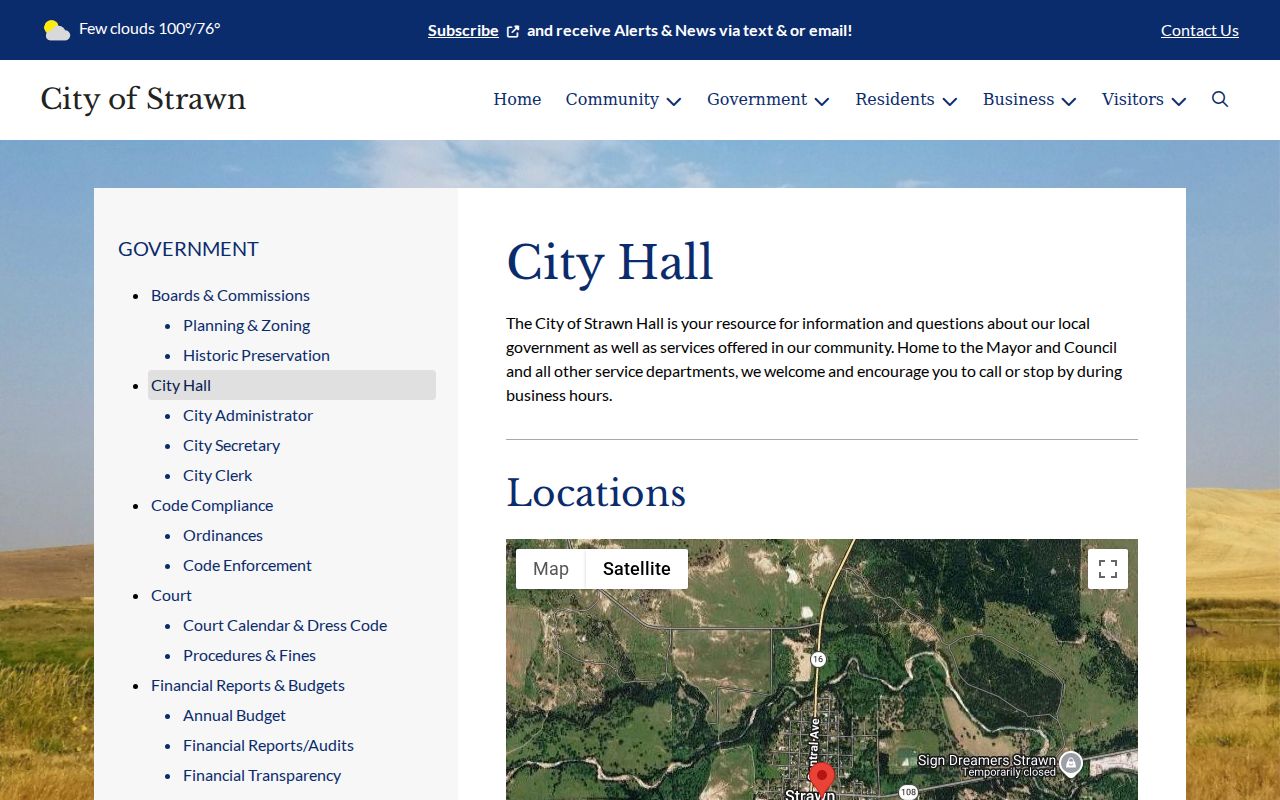
This city-level source is the practical front door for routing a Strawn record when no specialized police records counter is published.
Ask for an existing Strawn item, such as an incident report or named municipal document. No fee or response time was published in the researched Strawn pages, so confirm cost and delivery before ordering rather than relying on an assumed Strawn schedule. A narrow request also helps the secretary distinguish a police narrative from a citation, council record, or another municipal file.
The Strawn Police Department
The official Strawn Police Department page confirms the city police presence but publishes no distinct records-office address, copy form, online report portal, blotter, or department app. It also does not state a report fee or turnaround. The absence of those details should guide the request back to the City Secretary rather than to an invented police portal.
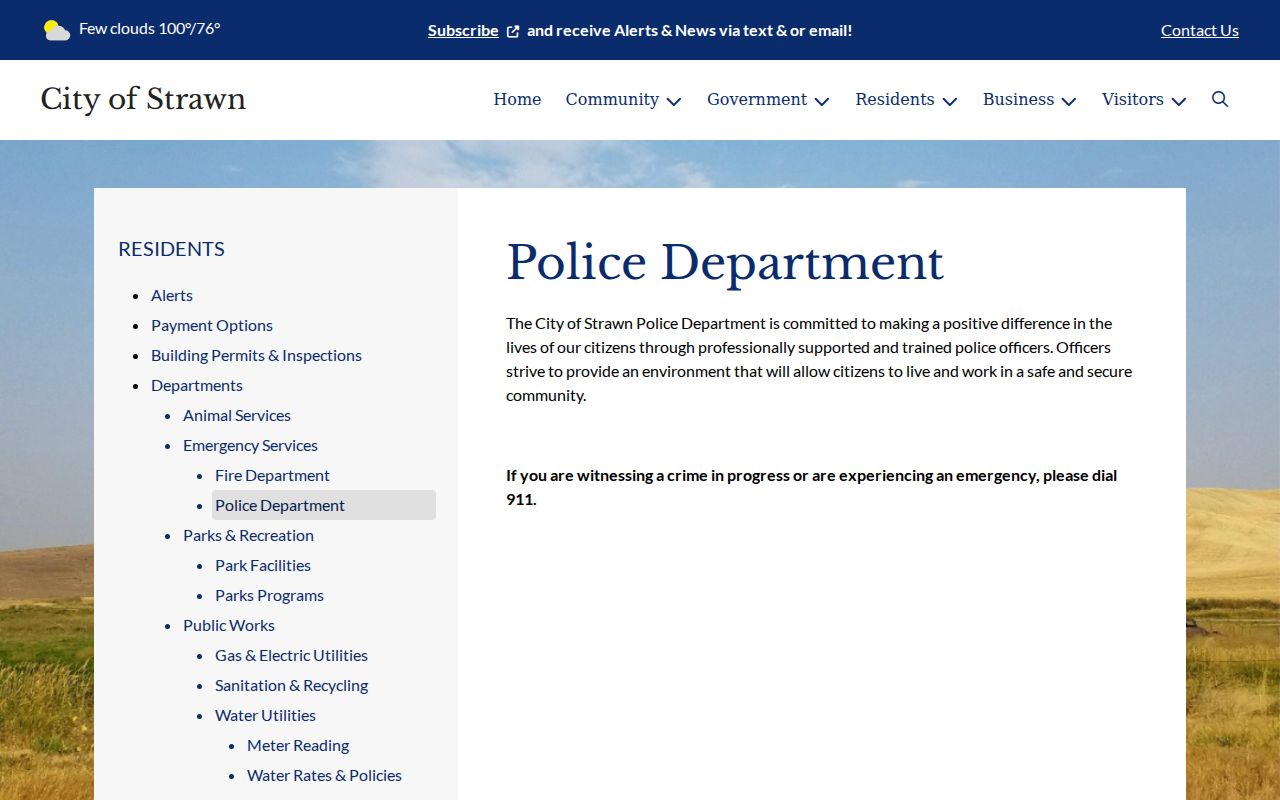
The sparse official page supports agency identification, while City Hall supplies the documented public-information route.
In a Strawn request, name “Strawn Police Department” as the department and describe the specific Strawn record. Include the incident or citation number when known, along with date, place, and the form of copy desired. If another agency handled the Strawn event, request its narrative from that actual responder instead. A county booking after arrest does not transfer ownership of the Strawn police report to the Sheriff.
Inside Strawn's Online Contact Form
Strawn’s general contact form includes a Department to Contact dropdown, Name, Email, Phone, Subject, Message, CAPTCHA, and submit control. The inspected page did not expose the dropdown options or required flags. It also did not promise that the form is a dedicated formal records portal. Those limits make the message text and saved acknowledgement important.
A useful Strawn message identifies the Strawn department, record type, incident or citation number, date, location, and preferred delivery method. Keep a copy or acknowledgement. The Strawn notice says email is retained under state law and may itself be subject to disclosure. That is a Strawn records-system fact, not a reason to add extra private details that are not needed to locate the document.
The official Strawn open-records page shows this municipal contact route.
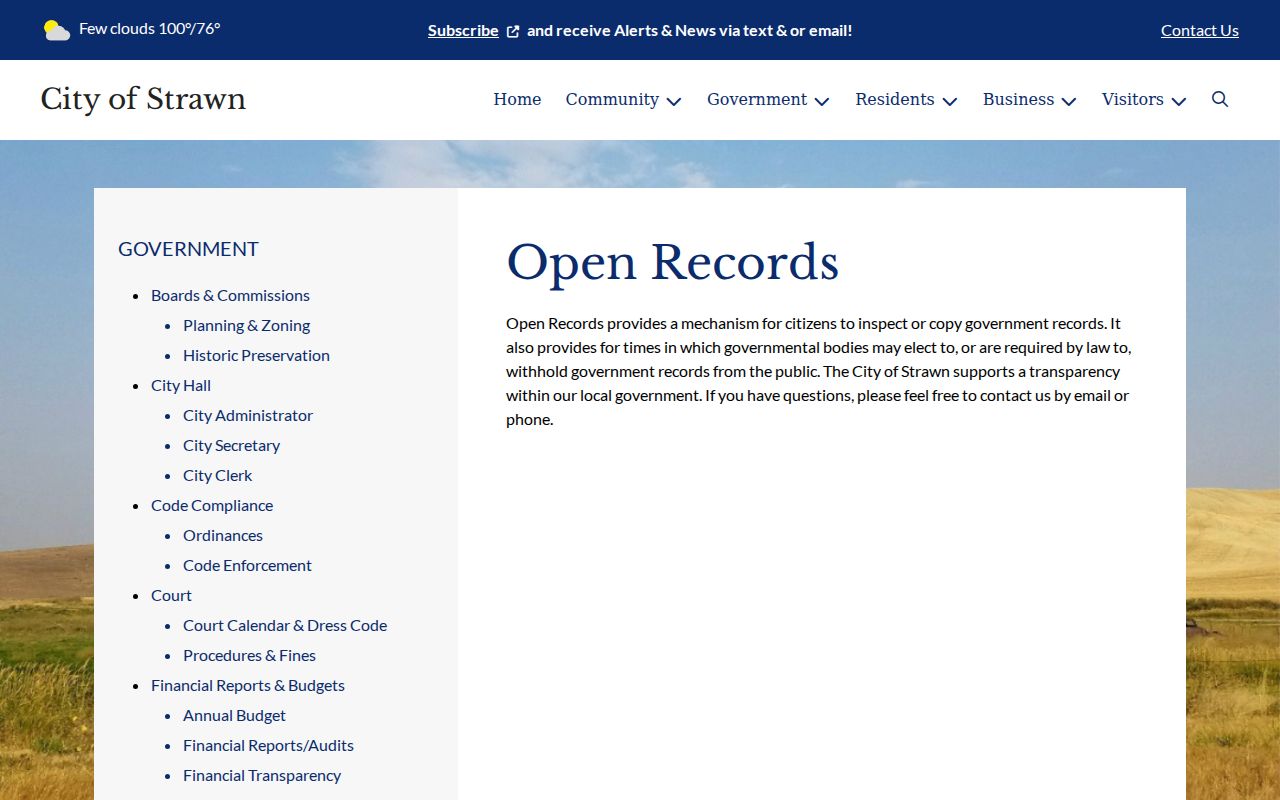
The screen gives a practical online starting point, but requesters should not treat it as a searchable police database or assume unpublished fees and deadlines.
Arrests and Bookings in Strawn
No separate Strawn city jail was advertised in the official material inspected. After a Strawn arrest, local custody should be traced through the Palo Pinto County jail roster. Its current-inmate, recent-arrest, and date archive views can help locate a booking, while the arresting agency remains the source for the incident narrative.
A Strawn-linked roster entry may show whether the person is currently booked or released, the arrest date, agency, bond, charge description, statute, warrant number, and court label. These fields describe intake and custody from a Strawn arrest, not the final judgment. A charge may later be rejected, changed, dismissed, deferred, tried, or resolved by plea.
If the Strawn booking is not visible, confirm which agency responded, ask the jail about custody, and request any releasable report from its actual custodian. The county-wide Palo Pinto arrest-history page gives fuller detail on the roster and Sheriff request channels.
Three Files From One Strawn Arrest
A Strawn arrest commonly creates three record tracks. First, Strawn police or another responding agency writes the incident and arrest report. Second, the Palo Pinto County jail creates booking and custody data. Third, a court creates a file if a prosecutor or city files a charge. Each track answers a different question and may update on a different schedule.
Strawn arrest timeline: Responding-agency report › county jail booking › municipal or county court file.
The Strawn incident report explains what the officer alleged and observed. The booking entry records custody from the Strawn arrest. The signed court disposition states the Strawn case result. When records conflict, compare identifiers and dates, then obtain the filed charging document and final order. A quick city contact cannot replace that court outcome, and a statewide name match cannot prove that two people with the same name are one person.
Strawn Municipal Court Records
Strawn Municipal Court handles the city’s applicable ordinance and fine-only matters. The official court page does not publish an online docket, search form, copy-fee table, or electronic case lookup. The verified access route is the clerk through City Hall at 118 E Housley Street, by phone at 254-672-5311, or by written mail to PO Box 581, Strawn, Texas 76475.
The official Strawn Municipal Court page is the source for that contact path.
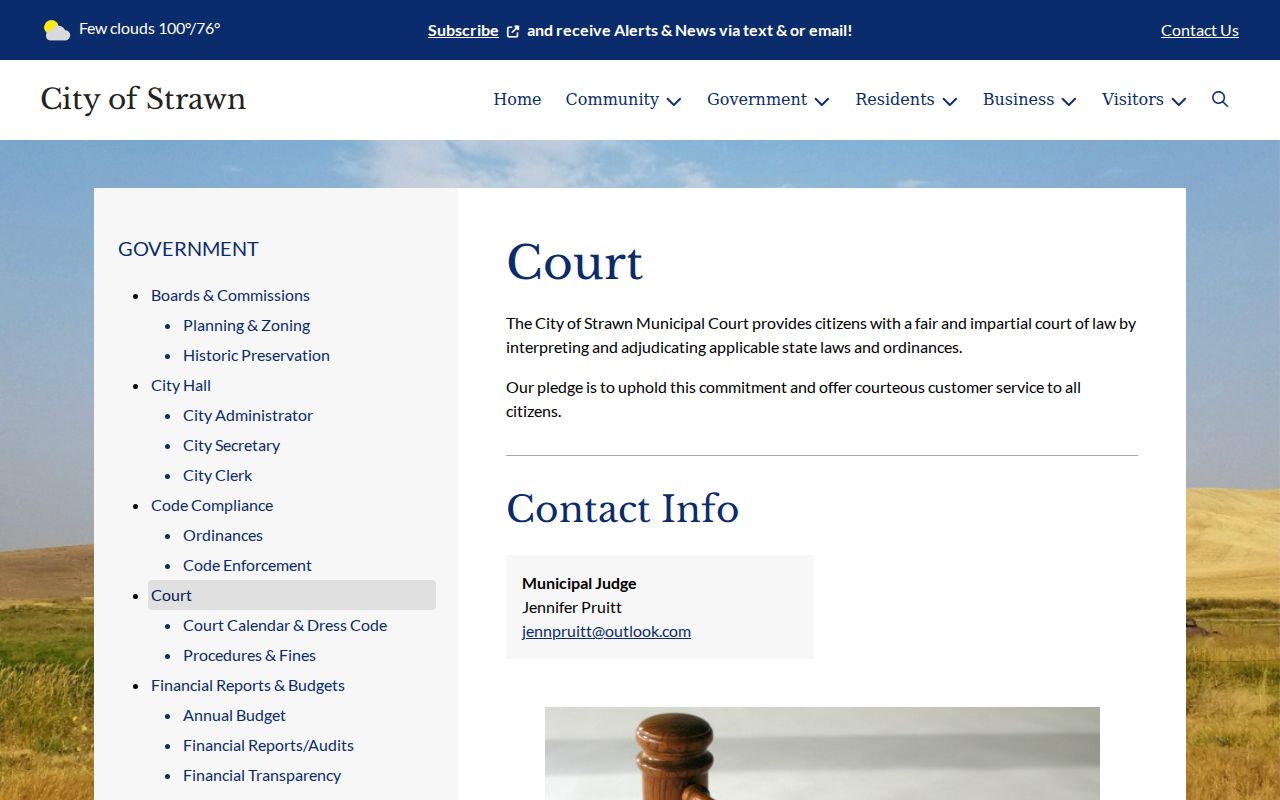
This court channel is for the municipal file, not felony or Class A/B misdemeanor records held by Palo Pinto County clerks.
| Court Name | Strawn Municipal Court |
|---|---|
| Case Types Heard | Applicable city ordinance, traffic, and other fine-only municipal matters. |
| Case Lookup Channel | Telephone, City Hall counter, or written request; no public online docket was verified. |
| What the Docket Shows | A municipal file may show citation or complaint, settings, plea, orders, payment status, and disposition where public. |
| Copies & Fees | No Strawn court copy fee was published in the inspected official source; confirm with the clerk. |
Strawn Citations Versus County Charges
The place of an incident does not determine which Strawn-area court holds the case. The level of charge and issuing court do. Strawn Municipal Court handles its eligible fine-only city matters. Justice courts handle qualifying precinct matters. The Palo Pinto County Clerk maintains Class A and B misdemeanor case records, and the District Clerk maintains felony filings in the 29th Judicial District Court.
| Record question | Starting office | Useful identifier |
|---|---|---|
| City ordinance or fine-only citation | Strawn Municipal Court | Citation or cause number |
| Class A/B misdemeanor prosecution | Palo Pinto County Clerk | Case number and filing date |
| Felony prosecution | Palo Pinto District Clerk | Cause number, court, and document name |
Ask the Strawn clerk to confirm the court shown on a Strawn citation if the file is not found. A Strawn police report alone does not tell the final charge or outcome. The signed disposition from the court is the best source for whether the Strawn matter ended in dismissal, deferred adjudication, acquittal, or conviction. For county cases, name the document needed, such as the charging instrument, docket sheet, judgment, or dismissal order.
Where Strawn Records End Up
City records do not all remain at Strawn City Hall. A local incident record stays with its creating agency, while a county jail file belongs to the Sheriff’s custody system. The municipal court keeps its own fine-only cases. Higher misdemeanor and felony files move through county clerks, and eligible outcomes are reported to the Texas Department of Public Safety.
Record flow: Strawn Police Department › Palo Pinto County Courts › Texas Department of Public Safety.
The Strawn flow is a route, not a guarantee that every detail appears at every stop. Texas DPS public CCH covers specified public conviction and deferred-adjudication data that has reached the repository. It does not reproduce every Strawn incident narrative, current jail event, or Strawn city citation. For a missing or disputed Strawn event, start with the original Strawn source and the final court disposition. A fingerprint-based personal review is the state route when identity certainty is required.
Strawn Geography Does Not Prove Jurisdiction
Strawn describes itself as less than four miles from Interstate 20, midway between Fort Worth and Abilene, and a gateway to the southern Palo Pinto Mountains. Ranching, six-man football, and nearby recreation are part of the city’s setting. None of those facts proves which agency responded to an event or supports a claim about local crime.
For Strawn record routing, use the exact location, date, agency name, and citation or report number. Highway, county, state, or local officers can create different files near the same Strawn community. If paperwork names a different responder, the Strawn City Secretary cannot supply that agency’s report merely because the event was near Strawn.
This distinction is especially useful when a Strawn mailing address and the actual jurisdiction do not line up neatly. Source labels are better evidence than local assumptions.
Strawn Crime Data Has Limits
The Texas Demographic Center estimated Strawn’s population at 550. No independently verified Strawn municipal crime series was located in the official sources reviewed. County Sheriff data should not be converted into a Strawn crime rate, and a county booking list should not be counted as a complete series of city offenses.
A reported Strawn event, a Strawn arrest, and a conviction are different measures. Strawn tourism, interstate access, park use, or community events do not support an inference that a certain crime pattern exists. Reliable Strawn record work stays with the source document: the incident report for the event, booking file for custody, and court disposition for the result.
When the goal is to review one’s own record, use exact names, dates, cause numbers, and the signed outcome rather than an unsupported local rate.
Public Access Rules
Strawn public-information requests operate under the Texas Public Information Act. The law generally permits access to government-held information unless an exception or another confidentiality law applies. It does not require the city to publish every police or court record in an online search. Juvenile information, protected victim details, and material tied to an active investigation may be closed or redacted under applicable law.
Request an existing Strawn document with enough detail to locate it. Avoid asking the office to create a new explanation or criminal-history report. Court access has its own sealing and confidentiality rules, and DPS public history has a narrower statutory scope.
Key Statutes:
Texas Government Code Chapter 552 governs public requests and the exceptions that may limit release.
Texas Government Code Section 411.135 authorizes public access to specified DPS conviction and deferred-adjudication data.
Texas judicial access standards address public court records while preserving lawful sealing and confidential information.
Keep the Strawn response acknowledgement and verify important results with the originating office. Email sent to the city is retained under state law and may itself be disclosable.